




Abstract
Background
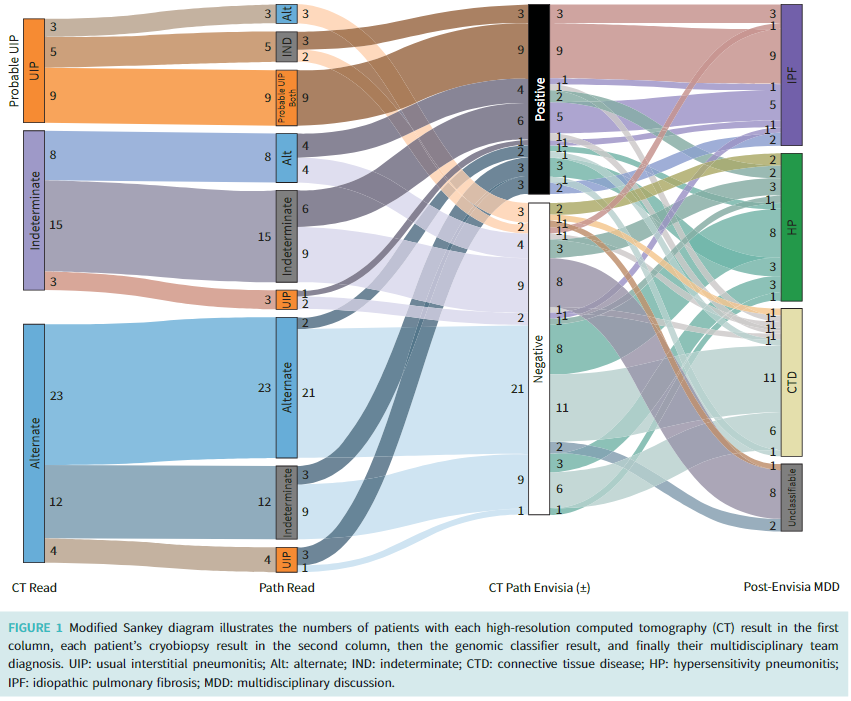
Interstitial lung disease (ILD) represents a heterogenous group of diseases that have substantial morbidity and mortality. The Envisia Genomic Classifier (EGC) is a test that analyses RNA derived from transbronchial biopsy (TBBx) samples to make a positive or negative genomic usual interstitial pneumonitis (UIP) designation. Our study assesses the ability for the EGC to predict progression of disease, with a longer duration of follow-up than previous studies.
Methods
Patients referred for cryobiopsy for outpatient workup of ILD concurrently had TBBx and EGC testing performed. We performed a retrospective analysis to assess differences in progression of disease between EGC-positive and negative patients, applying Kaplan–Meier survival analysis and log-rank tests. Confidence in ILD diagnosis before and after the EGC result was also noted, and the difference in confidence levels was assessed by a Wilcoxon signed-rank test.
Results
82 patient cases were analysed. EGC-positive patients had a shorter progression-free survival (PFS) than EGC-negative patients, (p<0.0001), with 622 versus 1487 median PFS days respectively. EGC-positive patients also had worse progression in the subsets of patients with “indeterminate for UIP” computed tomography (CT) (p=0.0052), “alternative diagnosis” CT (p=0.0144) and non-idiopathic pulmonary fibrosis ILD diagnosis (p=0.0157). Additionally, EGC increased the diagnostic confidence level (p<0.0001).
Conclusion
EGC positivity predicts worse ILD progression over a sustained follow-up period. The ability to predict worse prediction early in the ILD course without the need for surgical biopsy would have significant clinical impact.